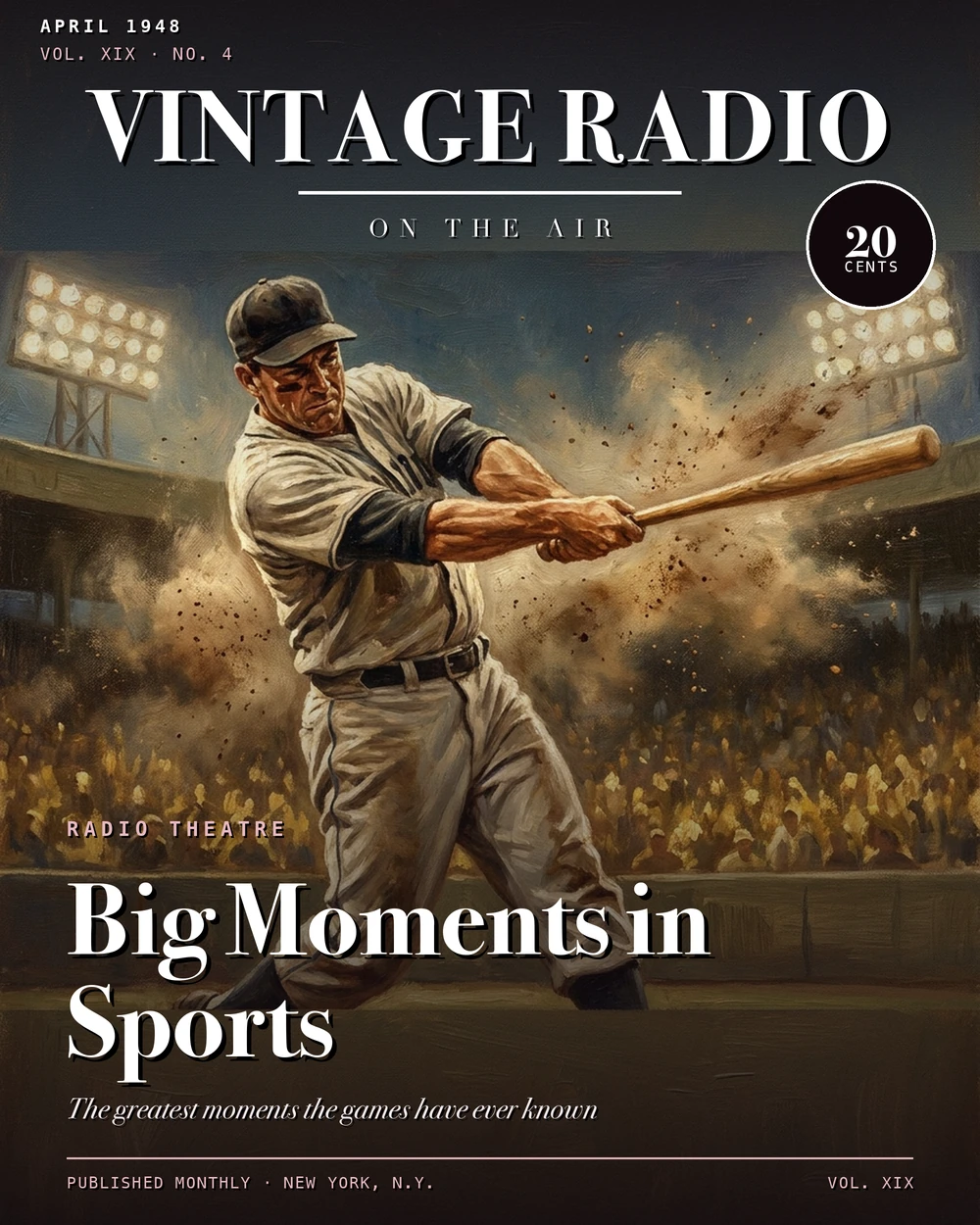
Big Moments in Sports
What the Show Was
Big Moments in Sports was a syndicated 15-minute radio program that aired in the summer of 1955, running from May 27 through July 22. Each episode followed a consistent formula: a narrator set up the historical circumstances around a famous sporting event, then the show moved into a dramatic recreation of the moment itself. The format was close in spirit to Bill Stern's long-running Colgate Sports Newsreel — which ran on NBC Blue, then NBC, then ABC from 1939 until June 1956 — though Big Moments in Sports had a notably different reason for existing.
The show was an Air Force recruiting vehicle, produced and sponsored by the United States Air Force to advertise careers in the service. That made it an unusual object: part sports drama, part military advertisement. Each episode wove recruiting spots for the Air Force in alongside the athletic storytelling, which gives the surviving recordings an extra layer of historical interest beyond the sports content itself.
The Episodes That Survive
Five episodes are known to exist, and together they cover a genuinely wide range — professional football, boxing, track and field, golf, and the Olympics — spread across a roughly weekly schedule over those two months.
The May 27 opener covered golfer Lew Worsham's win at the 1947 U.S. Open, the first U.S. Open to be televised locally, in which Worsham defeated Sam Snead by one stroke in an 18-hole playoff at St. Louis Country Club. On the final hole, tied with Snead, Worsham called for a measurement to determine who was farther from the cup. Snead, flustered, missed his putt. Worsham made his. The winner's share was $2,000.
The June 3 episode turned to Jesse Owens and the 1936 Berlin Olympics, where Owens won four gold medals in the 100 meters, 200 meters, long jump, and 4×100 relay. Three weeks later, on June 24, the show dramatized the December 5, 1947 heavyweight title fight at Madison Square Garden, in which Jersey Joe Walcott knocked Joe Louis down twice — in the first and fourth rounds — and most ringside writers scored the bout for Walcott. Louis retained the title anyway on a controversial split decision.
The July 1 episode went back to the December 24, 1950 NFL Championship Game, won by the Cleveland Browns over the Los Angeles Rams 30–28. That game featured 12 future Hall of Fame players and was described by NFL Commissioner Bert Bell as "the greatest game I have ever seen." It was also the first NFL title game carried on national network radio, broadcast by Red Barber on the Mutual Broadcasting System to 120 stations; the network paid $2,500 for the rights. The final episode, from July 22, covered the 1934 rivalry between milers Glenn Cunningham and Bill Bonthron: Cunningham — known as the Kansas Ironman — set a world mile record of 4:06.8 at Princeton on June 16, only for Bonthron to beat him at the NCAA Championships the following week and then set a world record in the 1500 meters.
Why It's Worth Knowing About
Big Moments in Sports ran for just two months and left behind only five episodes, so there's no long broadcast history to trace. What makes it interesting is the combination of what it was dramatizing and who was paying for it. The Air Force was a young branch of the military in 1955 — established as an independent service only in 1947 — and using dramatic sports recreations as a recruiting wrapper was an inventive approach to reaching a civilian audience. The episodes themselves landed on genuine historical material: a controversial heavyweight decision many thought Louis lost, a golf playoff won on a psychological gambit, and the first nationally broadcast NFL championship game. As a document of how sports were remembered and retold on radio in the mid-1950s, the series holds up as a compact, well-chosen set.